
Follow a manual added link
CT CONTROLLED
NERVE ROOT TREATMENT
CT CONTROLLED
FACET JOINT INFILTRATION
CT CONTROLLED
EPIDURAL REFLUX
At which location can you have pain management?
The various types of pain therapy are part of the extended spectrum of Radiologie München. Our specialists offer the various manifestations of pain therapies at different locations.
1
2
3
4
1
2
3
4
CT-guided nerve root treatment
(Periradicular Therapy – PRT)
The indication for pain therapy PRT is nerve root irritation syndromes. These are usually the result of a herniated disc and/or constriction of the nerve roots due to degenerative changes in the spine (spinal stenosis). Here, the anesthetic is applied directly to the exit point of the nerve root from the spinal canal.
Indications:
- all acute and chronic nerve root irritations
- Nerve root compression due to lumbar disc herniation
- monoradicular pain syndrome (pain radiating from a specific lumbar nerve root)
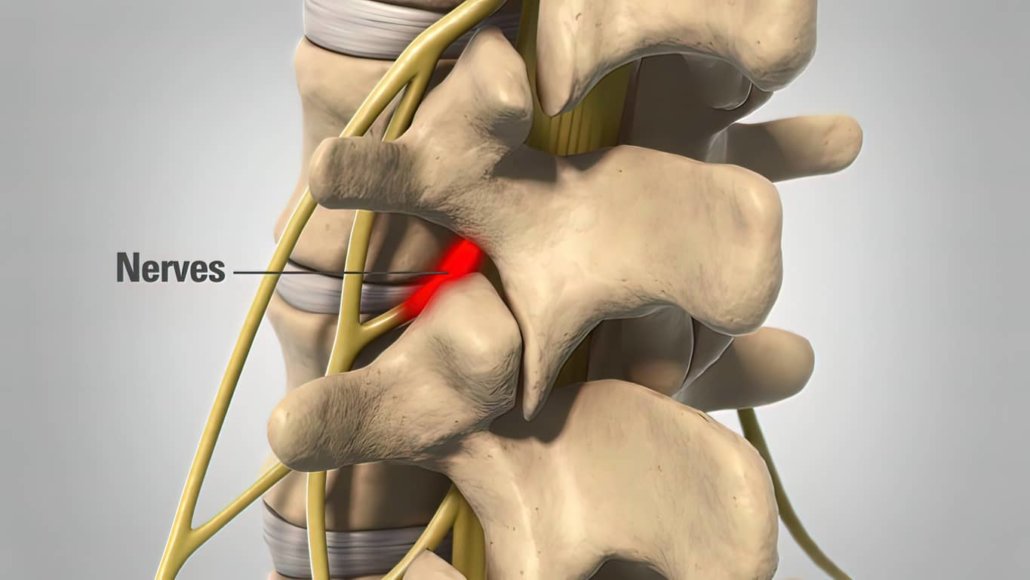
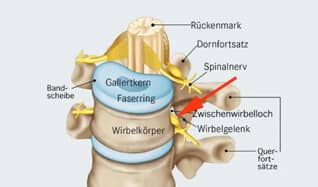
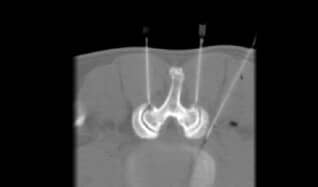
Procedure of periradicular pain therapy
For PRT, you will be placed in the supine or lateral position on the CT table. After the usual preparations and determination of the spinal segment to be treated, the coordinates are marked on the skin. Then the skin is disinfected several times and the treatment begins. With the help of image control, a thin injection needle is advanced to the immediate vicinity of the nerve root, under local anesthesia of the skin and muscles.
Small amounts of X-ray contrast medium or air are then injected to check the correct position of the needle. This allows the medication to be injected precisely at the affected nerve. During the injections, local anesthetics are also injected around the nerve. This usually causes the pain to subside immediately, but may cause temporary numbness with or without loss of strength in the legs or arms.
This can last for several hours and disappears again completely. This type of treatment can be repeated. If no improvement is achieved despite PRT, the indication for further interventional or surgical procedures will be discussed with you again.
CT-guided facet infiltration
(Infiltration of the small vertebral joints)
This infiltration method is mainly used for painful wear and tear of the small vertebral joints. It is not uncommon for the pain to be significantly more intense in the morning after waking up and to slowly subside throughout the day, but to increase in intensity again upon exertion.
Indications:
- persistent low back pain without sensorimotor deficits
- persistent neck or thoracic spine pain
- belt-shaped radiation of pain
- Sacral pain that cannot be assigned to a segment
- Arthrosis of the small vertebral joints (facet joint arthrosis)
Through a targeted pain therapy of the facet joints or blockade of the supplying nerves at the facet joints, an efficient supportive therapy of your back pain can be started.
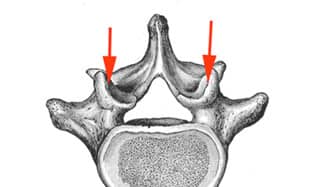
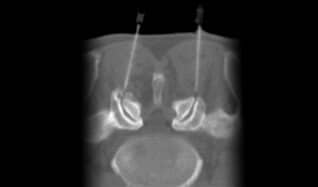
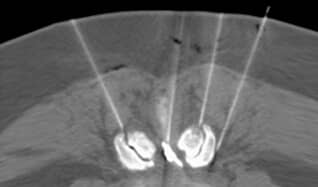
Sequence of facet infiltration
For facet blocks in the cervical, thoracic and lumbar spine, you will be positioned in the supine or lateral position on the CT table. After usual preparations, determination of coordinates on the skin and thorough skin disinfection, pain therapy can be started.
Under MRI or CT image guidance, a thin injection needle is advanced to the facet joints under local anesthesia. Small amounts of x-ray contrast media or air are then injected to ensure that the needle tip is not in vessels or nerves, and that the drugs to be injected achieve proper distribution.
After rechecking and possibly correcting the needle position, a mixture of local anesthetic and small amounts of cortisone is injected. The cannulas are then removed again.
CT-guided epidural flooding
Epidural flooding is performed similarly to PRT. The drugs are thereby
injected directly into the so-called epidural space, so that this method comes closest to the irritated nerve root as well as the herniated disc. The administration of a local anesthetic-cortisone mixture in a small dosage is therefore carried out directly at the site where the pain also occurs.
Indications:
- acute, radiating pain due to a herniated disc
- chronic pain syndrome due to nerve root irritation
- Postnucleotomy syndrome (pain after unsuccessful disc surgery)
Link to: Aktuelles