CT angiography
non-invasive & very accurate
A CT angiography is one of the very gentle examination methods for vessels and organs. No probes are inserted into the veins or arteries; only a contrast agent is administered.
With the multislice computed tomography (CT angiography) used, blood vessels, such as arteries and veins, can be easily, safely and quickly visualized. The images can be output both as coloured images and as freely rotatable 3D representations. This makes diagnosis by the specialist team at Radiology Munich much easier and also improves diagnostic certainty.
max. 30 min
Duration of examination
approx. 60 min
Time in practice
CT angiography in Munich
We offer angiography by means of CT at various locations in our network of practices. Our experts will conduct a detailed initial consultation to clarify the procedure and possible limitations of the examination, such as allergies.
1
2
3
4
5
6
7
8
9
1
2
3
4
5
6
7
8
9
What exactly is CT angiography?
CT angiography, like MR angiography, is a noninvasive vascular imaging procedure. By reconstructing the generated image data sets, a three-dimensional representation is possible. Here, too, vasoconstrictions or vasodilatations (e.g. an aneurysm) can be visualized. The examination, which takes only a few seconds, requires the administration of an iodine-containing contrast medium via a vein in the arm.
What happens during a CT angiography?
CT angiography is a radiological procedure that uses X-rays to create images of blood vessels from different parts of the body. The previously injected contrast agent can be used to image constrictions, occlusions, bleeding, or abnormalities of the arteries.
Then our experts determine the corresponding results. The assessment of the imaged body region, including vessels, can subsequently be performed via the screen or later via the digital, saved version.
When is CT angiography necessary?
CT angiography is widely used as a diagnostic procedure in various fields. Among others, images are generated from:
CT angiography is particularly suitable for patients with pacemakers, as magnetic resonance imaging (MRI) is often not possible. However, restless patients also benefit from the short examination times and the open and spacious CT scanners.
What do you need to know before the treatment?
As a rule, CT angiography takes place on an outpatient basis. The examination is performed with contrast media containing iodine, which is why patients are not allowed to eat or drink anything for four hours before the examination begins.
In addition, before performing a CT angiography, it is recommended that the kidney function be tested to rule out problems caused by the contrast agent. A blood sample analysis in the laboratory is sufficient for this.
What is the procedure for a CT angiography?
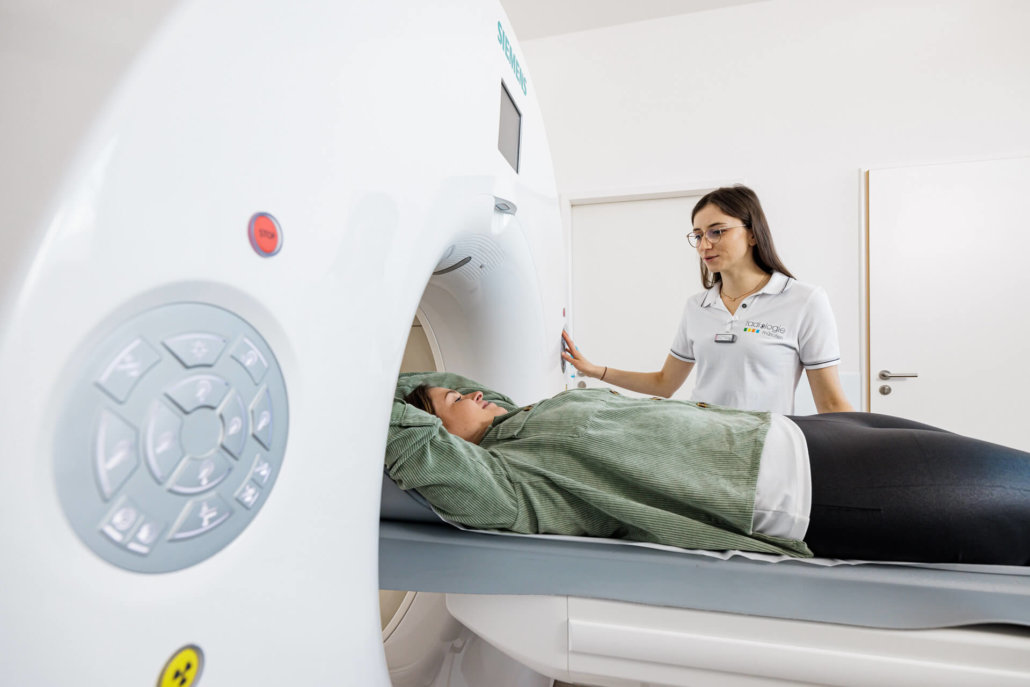
CT angiography studies require administration of a contrast agent through the brachial vein. The examination takes place after the injection, lying on the back.
In the process, you are driven through the wide opening of the CT unit several times – the individual measurements are taken within a few seconds. During the examination, you will also have to hold your breath at certain intervals on the instructions of the medical staff. This increases the image quality of the vessels depending on the question and body region.
What are the risks of CT angiography?
CT angiography is a low-risk examination procedure. However, allergic reactions or a thyrotoxic crisis – a metabolic derailment that can occur in hyperthyroidism – can occur in relation to the use of the iodine-containing contrast medium.
In the case of diabetes or renal insufficiency, the contrast agent may cause deterioration of renal function. To avoid this and other risks, patients must fill out a standard questionnaire before the examination. If there is an allergy to the contrast agent, CT angiography will not be performed.
CT
More about computed tomography as an examination
MR angiography
Interesting facts about MR-based vascular diagnostics
Angiography
Back to the overview of diagnostics by angiography
Link to: Aktuelles