
Coronary calcification measurement by CT
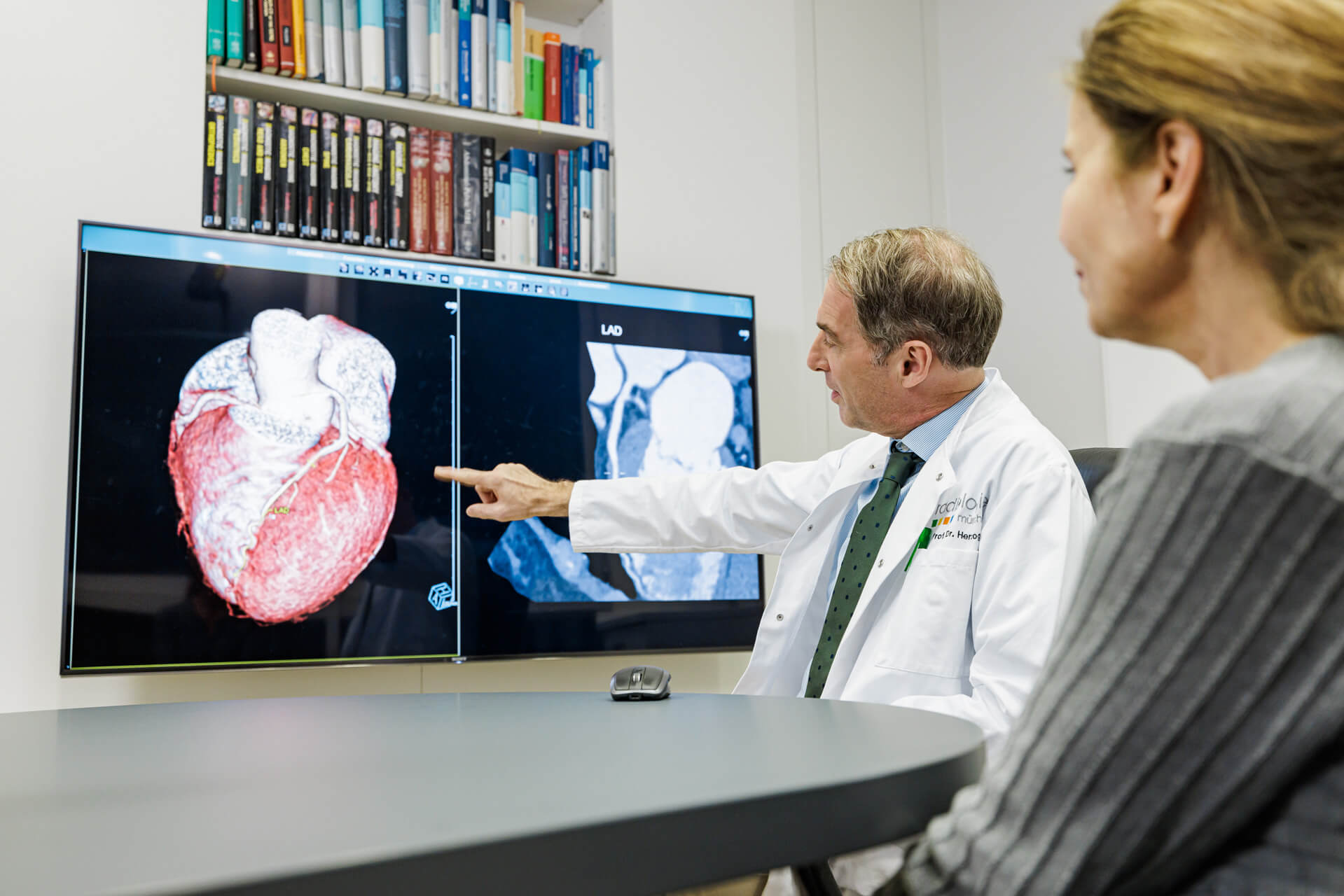
CT coronary calcification makes calcifications of the coronary vessels visible. Calcification only occurs when coronary artery disease is present. The computer-assisted evaluation not only makes it possible to detect coronary artery disease, it also provides information about the extent of the calcification.
max. 10 min
Duration of examination
approx. 30 min
Time in practice
Where can you have a CT for coronary calcium measurement in Munich?
Computed tomography (CT) can easily and reliably detect calcifications of the coronary arteries. The necessary image acquisition is only available at special computer tomographs – our practice offers this diagnostic possibility.

What happens during a CT coronary calcium measurement?
Using our innovative equipment, our specialists can easily and reliably detect calcifications of the coronary arteries during a computed tomography (CT) scan. The dual-source CT we use allows us to record per heartbeat – even at higher heart rates. As a result, the device operates with a very low radiation exposure – well below 1 mSv in total per complete examination.
Compared to cardiac catheterization and conventional computed tomography, this leads to a dose reduction of about three quarters. Currently, this technique is available at only a few centers worldwide, and in Germany at only 3 locations outside our practice.
4 mSievert
natural radiation exposure per year
How is the evaluation performed for a CT coronary calcium measurement?
We document various values during our examination in the so-called calcium score:
- Calcification degree
- Lime quantity
- effective amount of lime (the so-called hydroxyapatite)
This allows changes to be tracked more reliably and, above all, more reproducibly. The degree of calcification in coronary arteries is an important indicator of the risk of infarction. The higher the calcification, the more likely a heart attack will occur within the next 5 years. If the coronary calcium is absent – score value zero – the risk in said period is less than 5%.
What factors play a role in the evaluation?
In addition to the level of the calcium score, the age and sex of the patient also play a role. With increasing age, the degree of calcification of the coronary vessels increases independently of other risk factors. Therefore, the evaluation is always corrected for gender and age in order to be able to optimally estimate the individual risk.
What do you need to know before the treatment?
Basically, there is little for you to consider in preparing for a CT coronary calcium measurement. If possible, you should only eat a light breakfast on the day of the examination – otherwise drink as usual. The only exception – we ask you to abstain from alcohol. In addition, we need all documents on previous diagnostic examinations of the cardiovascular system. Also important are documents about treatments performed. We ask that you bring everything with you if possible.
Medication is usually not a big problem. Since no contrast agents are used, there are hardly any incompatibilities of the treatment. However, if you suffer from claustrophobia, our specialists can discuss Due to the open design of the devices used, there is a high probability that the patients concerned will find the examination less disturbing.
What is the procedure for a CT coronary calcium measurement?
In the preliminary consultation, our specialists explain the upcoming procedures in detail. Since the administration of a contrast agent is unnecessary, the examination starts after the interview. The patients are pushed through the wide opening of the dual-source CT in a lying position and equipped with headphones. This is done fully automatically.
The examining staff occasionally gives indications or instructions over the headphones. Noise pollution during image generation is minimal. Nevertheless, the dual-source CT units generate outstandingly sharp images. Due to this technology, examination times have also decreased enormously and are now only a few minutes. Afterwards, our specialists will discuss the obtained images and results with you.
Cardiac CT
Spatial & temporal imaging using CT
Cardiac MRI
Imaging of the heart with MRI
Cardiac diagnostics
Back to the overview of cardiac diagnostics
Link to: Aktuelles