PET-CT
means positronemission tomography/ computed tomography
Our PET/CT in Munich combines two types of examination in one device. Computer tomography is used to assess the anatomy of the body. At the same time, PET can be used to obtain information about certain metabolic processes in the tissue.
PET/CT scanning with F18-PSMA is useful in many patients with prostate cancer. The most important indications and other information can be found under “more info”.
We are very pleased that we can also offer PET/CT diagnostics as an outpatient service in our practice in Munich Großhadern.
With the Biograph 40mCT from Siemens, we have a PET/CT of the latest generation available for the care of our patients. In combination with the 3-Tesla MRI, the computer tomograph and of course our radiotherapy, we can offer complete outpatient diagnostics and therapy of many tumor diseases.
Feel free to contact us directly through any of the following channels! You can contact us by telephone during the practice hours of our location at Max-Lebsche-Platz in Munich Großhadern ( Mon-Fri from 8 a.m. to 6 p.m.) on 0049 89 2121 96 535.
Please feel free to use our registration forms, which you can send to us by e-mail to petct@radiologie-muenchen.de or by letter.
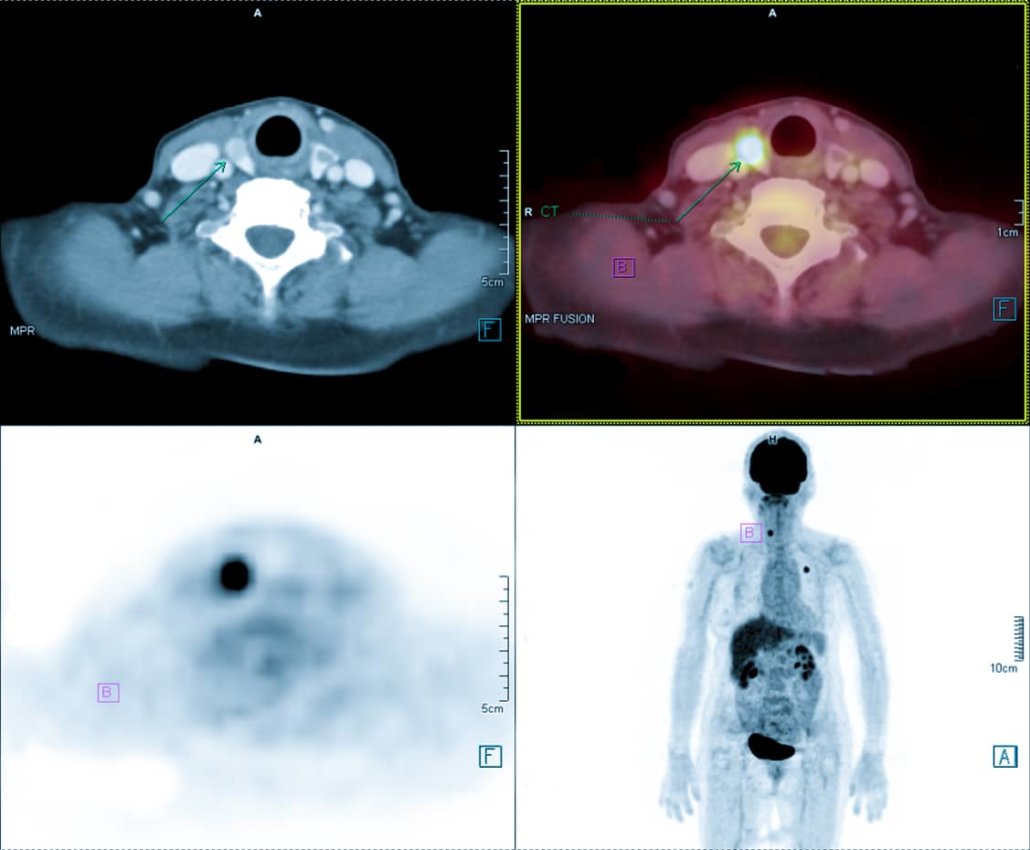
PET/CT combines two types of examination in one device. High-resolution cross-sectional images of the body can be generated using a computer tomograph. Here, the radiologist assesses the anatomy of the body and can identify and assign organ changes (e.g., metastases) based on their nature. At the same time, the nuclear medicine procedure of PET can be used to make a statement about certain metabolic processes of the tissue.
Before the PET examination, the patient is injected with a weakly radioactive substance in the arm vein, which is distributed throughout the body. Allergic reactions hardly ever occur. The natural decay of the injected substances produces a weak radiation that allows the physician to visualize the distribution of the substance in the body. By means of computer tomography (CT), which is performed at the same time, these metabolic processes can be precisely assigned anatomically in the body.
means positronemission tomography/ computed tomography
The most commonly used substance in PET/CT diagnostics is a radiolabeled glucose that represents the metabolism of cells (18F-FDG). Since many tumor cells have an increased metabolism (for example, due to their rapid growth), they can be localized in this way. Put simply, only PET/CT can answer two fundamentally different but very important questions simultaneously.
First, “What does the tissue look like?”, and second, “What are its biochemical properties?”. Imagine, for example, a malignant tumor disease that fortunately responds very well to chemotherapy. Often, tumor sites show changes in your metabolism long before they finally get smaller. As chemotherapy disrupts the metabolism of tumor cells, their uptake of radiolabeled glucose is reduced. The physician can therefore make a statement much earlier about whether the chosen chemotherapy is the right one or whether the therapy regimen needs to be changed. He can only do this because he not only assesses the anatomy, but also because he “sees” the sugar metabolism of the tumor cells in the PET.
Studies have proven that PET-CT examinations with the weakly radioactive substance F18-PSMA(prostate-specificmembrane antigen) are among the most modern diagnostic options for prostate cancer. Often offered only in university hospitals, we as specialists have focused on this excellent diagnostic option. The fields of application are manifold:
We have summarized the technical conditions for you here.
For the best possible image quality, it is essential that you are fasting for approximately 8 hours prior to the examination. You can drink unsweetened liquids such as tea or mineral water. For diabetics, the examination can still be performed if certain rules are observed, which we will be happy to clarify with your referring physician in advance.
Please bring your available preliminary examinations, examination images on CD and reports of findings. In addition, the following laboratory values are required in as up-to-date a form as possible (not older than 4 weeks):
Any additional medication required during the examination will impair your fitness to drive . After the examination, there is therefore generally no insurance cover at the wheel! Therefore, we advise having a companion present when a PSMA PET-CT is scheduled. There are plenty of parking spaces in front of our practice in Großhadern.
IMPORTANT: If you are unable to come to the exam, please let us know by 9am the day before the exam. Otherwise, we will have to charge you extra for the radioactive examination agent ordered and produced individually for you. The reason for this is that the drug can only be used on your premises – the cost of a missed examination will then amount to approximately €200.
Please be at our practice on time at the appointed time. The total length of stay in our practice is approximately 3 hours. At the beginning of the examination, we discuss the examination procedure, measure the blood glucose and place an access in one of the arm veins. In order to be able to make optimal statements, a contrast medium containing iodine is often required for computed tomography. Of course, we explain this to our patients in detail. A known intolerance to contrast media must be disclosed. Necessary for further examination are current laboratory values for thyroid and kidney function (TSH and creatinine).
To further reduce radiation exposure, our patients receive a diuretic medication (Lasix). As a result, the weakly radiating substance is excreted more quickly. In addition, a drug that calms the gastrointestinal tract. We often use Buscopan. The background of this drug administration is to improve the image quality during imaging.
After the administration of the low-level radioactive examination substance, you should rest for at least 15-20 minutes. For this we have special recliners or couches. The examination begins approx. 45-70 minutes after administration of the examination substance. Just before that, you can change in a lockable locker room. You do not need to undress for the examination.
Larger metallic objects (e.g. belt buckles and underwire bra) must be removed. Please ask again about piercings when you register. The exposure is then performed while the patient is lying down and takes about 20 – 30 minutes.
Very large amounts of data are collected during a PET/CT examination. These are first checked for quality, so that the examination is not terminated until everything is in order. The evaluation of the examination results and the preparation of a report of the findings is time-consuming even for experienced examiners. If we cannot discuss the findings with you right away on site, we will try to give you an initial assessment.
The images of the examination will be given to you burned on a CD on the day of the examination. However, due to the large amount of data, this can take up to 30 minutes after the examination is completed. In the future, you will also be able to download the data via our patient platform. You will receive the necessary access data from our team on site directly after the examination.
The completed findings report is sent directly to your attending physician. If you wish, you will of course also receive a copy by mail to your home. This will also be expanded in the future via the digital option of our patient platform. If you have any questions about this, we will be happy to clarify them for you.
The diagnosis and staging of various tumor diseases as well as therapy monitoring are the most frequent questions posed to PET/CT. In the case of lung cancer tumors, the costs of PET/CT are covered by the statutory health insurance funds as an outpatient service (on referral slip) without any questions asked. Certain types of lymphoma, tumors of the ear, nose and throat, and laryngeal cancer have also been classified as eligible for reimbursement in recent years.
We check whether there is a clearly reimbursable diagnosis for all our patients with health insurance when they register for the examination. If this is not the case, but the examination is deemed necessary from a medical point of view by your treating physicians, an individual application for cost coverage must be submitted to your health insurance company. We will be happy to assist you with the application process.
We usually receive a quick response from your health insurance company here. If the health insurance company does not cover the costs of the examination, there is still the option of having the examination performed as an individual health service (IGeL). We will be happy to provide you with a cost estimate for this. Private health insurances usually cover the costs for medically justified and necessary questions. But again, you can make an advance request to your insurance company.
<strong>Indication with secure GKV cost coverage</strong>
Unfortunately, there are still major differences in the reimbursement structure between patients with statutory and private health insurance. From a medical point of view, the restrictive attitude of the SHI is hardly comprehensible. For a better overview, the indications that can also be performed on patients with statutory health insurance are prefixed.
<strong>Indications with individual application for cost coverage by GKV</strong>
The following indications must be applied for individually with the GKV:
You need to load content from reCAPTCHA to submit the form. Please note that doing so will share data with third-party providers.
More InformationYou are currently viewing a placeholder content from Facebook. To access the actual content, click the button below. Please note that doing so will share data with third-party providers.
More InformationYou need to load content from reCAPTCHA to submit the form. Please note that doing so will share data with third-party providers.
More InformationYou are currently viewing a placeholder content from Instagram. To access the actual content, click the button below. Please note that doing so will share data with third-party providers.
More InformationYou are currently viewing a placeholder content from X. To access the actual content, click the button below. Please note that doing so will share data with third-party providers.
More Information